Applications

Fiber-optic sensing for hard-to-measure environments

Nusenics develops fiber-optic sensing technologies for measurement needs where conventional electronic sensors can be limited by electromagnetic interference, high temperature, radiation, deployment geometry, or difficult access.

Primary application areas

Application-driven sensing platforms

Fusion diagnostics

Plasma radiation measurement

Magnetic-confinement fusion devices require spatially resolved measurement of plasma radiation to support energy balance analysis, radiation-loss control, heat-exhaust management, and disruption-relevant monitoring.

Conventional electronic bolometer systems are widely used for fusion radiometry, but deployment in fusion environments can introduce practical constraints related to electromagnetic interference, remote signal transmission, sensor size, channel density, and thermal gradients between measurement and reference elements.

Nusenics is developing fiber-optic bolometer technology for compact, optically interrogated radiation sensing. The approach uses optical signal transmission rather than electrical sensing at the measurement head, supporting deployment concepts where EMI tolerance, compact packaging, and multi-channel layouts are important.

Relevant technology Fiber-Optic Bolometer

Application fit: plasma radiation diagnostics, radiation profile measurement, heat-exhaust studies, disruption-relevant monitoring, and compact bolometer arrays.
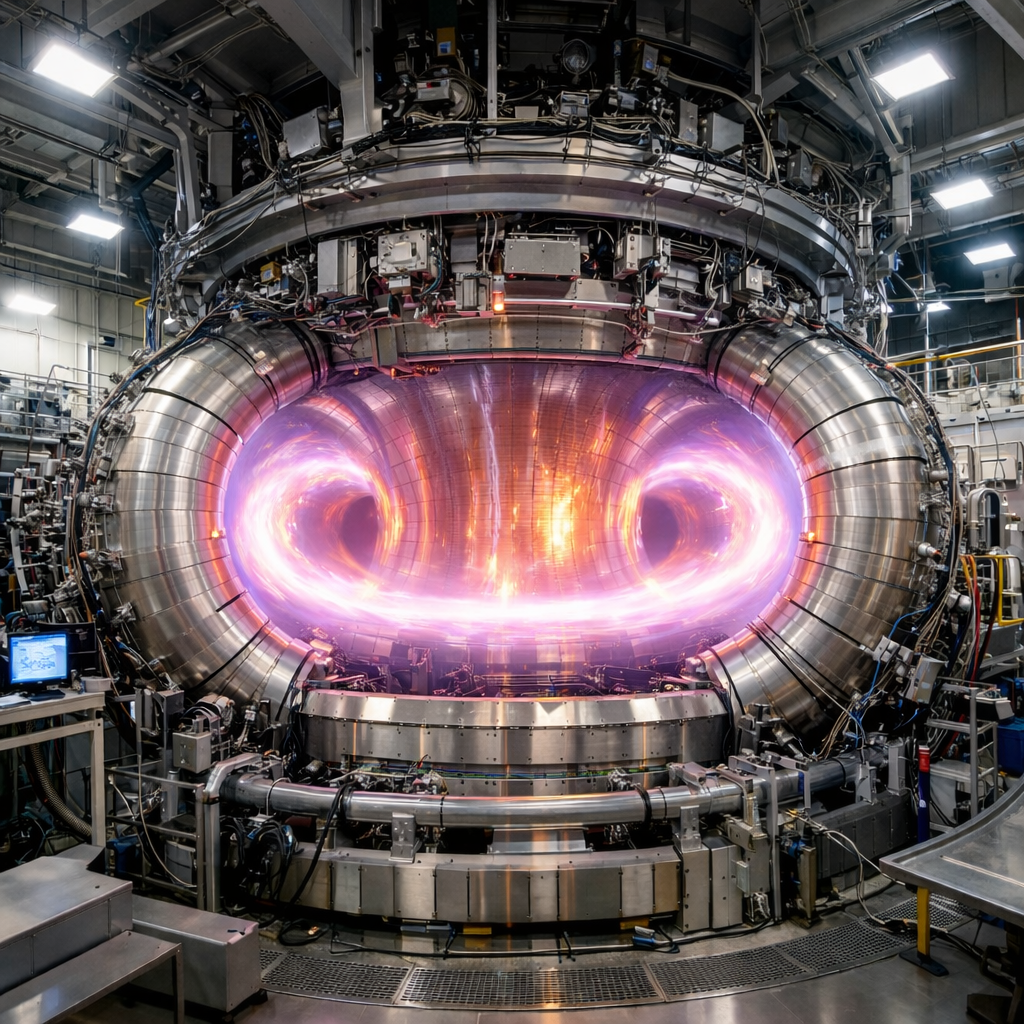

Fusion energy application representative image

Fusion edge diagnostics

Neutral gas pressure measurement

Neutral gas pressure in the divertor and scrape-off layer is an important parameter for understanding plasma-edge behavior, plasma detachment, heat-exhaust management, impurity transport, and plasma-facing component interactions.

Measuring neutral pressure in these regions is difficult because diagnostic hardware must operate near strong magnetic fields, high electromagnetic noise, constrained installation volumes, and complex plasma-facing structures. Conventional ionization-based gauges rely on electrical operation and can require careful shielding, alignment, and packaging.

Nusenics is developing a Fiber-Optic Neutral Pressure Gauge for localized neutral pressure sensing in fusion environments. The sensor uses an optically interrogated Fabry-Perot structure at the fiber tip. Pressure-dependent heat transfer between a photothermally heated microscale silicon structure and the surrounding neutral gas produces a measurable optical response.

Relevant technology Fiber-Optic Neutral Pressure Gauge

Application fit: divertor diagnostics, scrape-off-layer neutral pressure measurement, plasma-edge studies, detachment monitoring, and compact multi-point pressure sensing.

Fusion neutral pressure diagnostics representative image

Ocean measurement

Thermal microstructure measurement

Ocean turbulence studies require temperature sensors capable of resolving rapid, small-scale thermal fluctuations during field deployment. These measurements support research on ocean mixing, stratification, heat transport, and climate-relevant ocean dynamics.

FP07 thermistors have been widely used for thermal microstructure measurements, but conventional thermistor probes can be limited by finite frequency response and mechanical fragility in field use.

Nusenics is developing a high-speed fiber-optic temperature sensor based on a microscale silicon Fabry-Perot sensing element at the tip of an optical fiber. The small thermal mass, silicon material properties, and stress-free cantilever probe structure support fast thermal response and improved physical robustness for field-oriented temperature sensing.

In development testing, the sensor has demonstrated a plunge-into-water time constant of approximately 0.5 ms, supporting its potential use in high-bandwidth ocean thermal microstructure measurements.

Relevant technology Fiber-Optic Ultrafast Temperature Sensor

Application fit: ocean turbulence research, thermal microstructure profiling, high-speed temperature fluctuation measurement, and marine field instrumentation.

Ocean turbulence measurement representative image

Additional emerging application areas

Pipeline technologies for harsh-environment monitoring

High-temperature monitoring

Acoustic emission sensing

Fiber-optic acoustic emission sensing is being developed for structural health monitoring, materials damage detection, and event monitoring in environments where conventional piezoelectric or electronic AE sensors may face limitations from temperature, electromagnetic interference, or survivability constraints.

Stable thermal measurement

Drift-resistant temperature sensing

Drift-resistant fiber-optic temperature sensing is being developed for applications where long-term measurement stability is important, including energy systems, industrial equipment, and hard-to-access monitoring locations.

Customer fit

When fiber-optic sensing may be relevant

Electromagnetic interference

Optical sensing and fiber-based signal transmission can support measurement strategies in environments where electrical signals are affected by strong EMI or magnetic fields.

Compact installation

Microscale sensing structures and fiber-based packaging can help address measurement locations with limited physical access or tight integration constraints.

Remote interrogation

Fiber-optic architectures allow sensitive components such as light sources and demodulation electronics to be located away from the most challenging measurement environment.

Discuss an application

Working on a difficult sensing problem?

Nusenics welcomes conversations with customers, collaborators, and partners developing measurement systems for fusion energy, ocean research, industrial monitoring, and other demanding environments.